
The gift plant guide: when to send a living plant instead of a bouquet
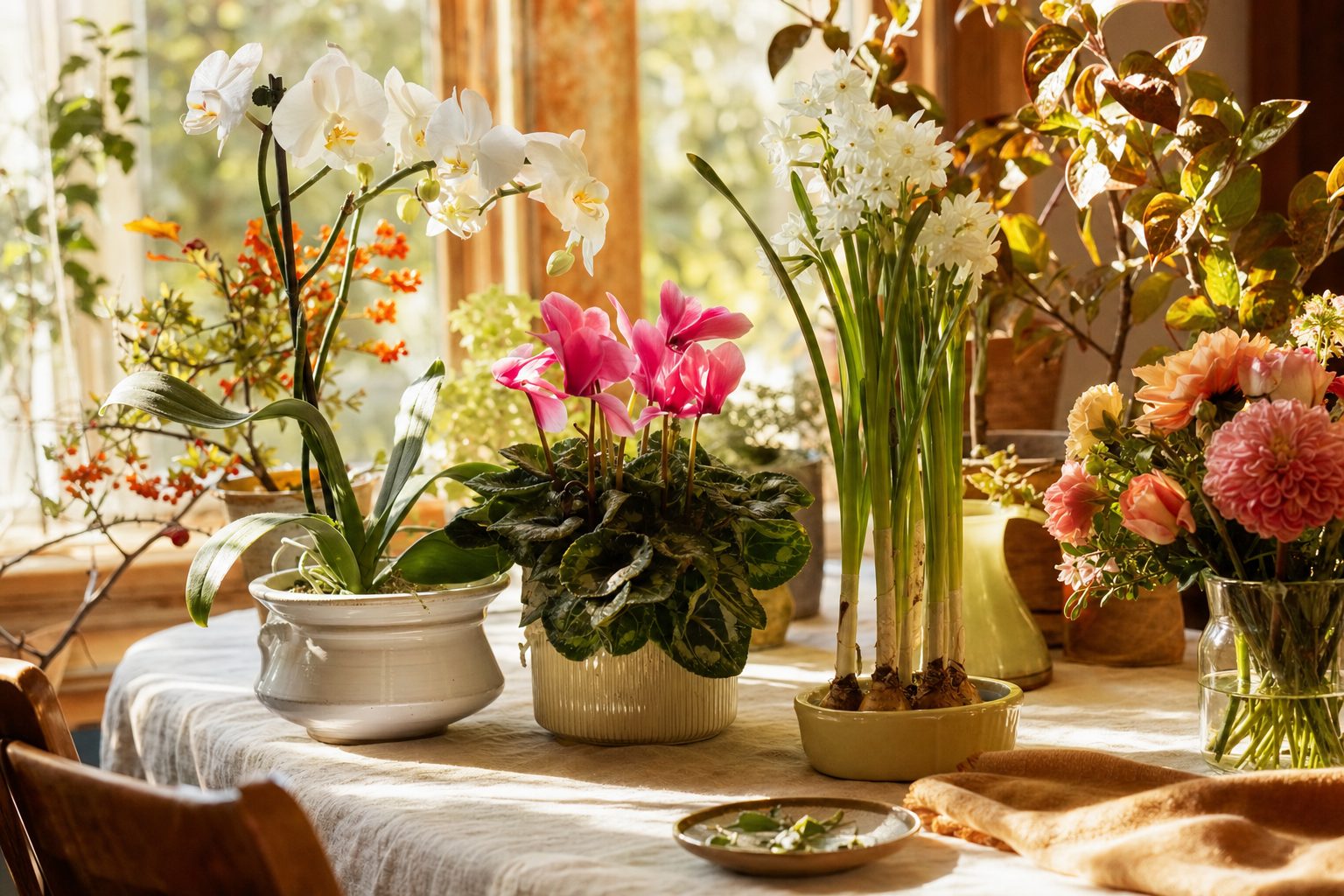
There is a moment every October when the flower shop starts to change shape. The buckets thin out a little, the branches come in, and along the back wall a quiet army of pots appears: orchids in ceramic cachepots, cyclamen with their swept-back petals, bulb pans with green noses just breaking the soil. Plants are the cold-weather half of the florist's business, and most buyers walk right past them on the way to the cut flowers. That is often a mistake. A living plant is the right gift more often than people think, and the wrong gift more spectacularly than people expect. The difference is almost entirely about who is receiving it.
What a plant communicates that a bouquet does not
Cut flowers are generous precisely because they end. They are a week of beauty with no obligation attached, which is why they work for apologies, congratulations, first dates, and the vague middle ground of "I was thinking about you." A plant says something different. A plant says: here is a thing that will be in your house for months, possibly years, and you are now responsible for it. That is a lovely message to send someone who gardens, someone settling into a new home, or someone who has just come through a long stretch and could use something that keeps going. It is a slightly awkward message to send a person who travels four days a week and has killed every basil plant they have ever owned.
So the first question is never "what plant should I send?" It is "does this person want a dependent?" Plenty of people do. Plenty do not, and no amount of ribbon changes that. If you are unsure, the honest hedge is a plant with an obvious finish line, like a forced bulb pan that blooms, fades, and gets composted without guilt. Nobody feels judged by a paperwhite.
Who actually wants a living plant
The reliable yes list is longer than you would guess. Someone moving into a first apartment with bare windowsills. Someone in a long recovery at home, where a bouquet feels like it is counting down the days. A colleague retiring, who now has time and light and no commute. Grandparents, who have usually kept houseplants for decades and have strong opinions about them. People who have recently lost a pet or a person and want something alive in the room. Anyone who has ever said the phrase "I just love a good African violet" out loud.
The no list matters more. Avoid sending plants to hospital rooms, where soil is frequently banned outright in oncology and transplant units. Think twice before sending one to a new parent, who has roughly negative time for watering schedules, unless you know they are the plant type. Skip plants for people in the middle of a move, people who have just told you their apartment is dark, and anyone you are apologizing to, because a plant that needs care reads as a second task rather than an amends. For that particular situation, our guide to apology flowers covers the ground better than any orchid can.
The plants worth sending, honestly assessed
Florists stock a narrower range than garden centers, and the narrowness is a feature. These are the plants that survive a van ride, a doorstep, and a recipient who is not an expert.
Phalaenopsis orchid. The default gift plant of the last twenty years, and deservedly so. A healthy phal holds its bloom spike for six to twelve weeks, sometimes longer in a cool room, and asks for roughly one ice-cube-sized drink a week. It looks far more expensive than it costs. It also rebloooms for patient owners, which means your gift can show up again next winter. If the recipient has never kept one, send our orchid care guide for normal people along with it, because the single biggest orchid killer is love expressed as overwatering.
Cyclamen. Underrated, extremely seasonal, and perfect right now. Cyclamen want cool rooms and bright indirect light, which describes most American houses from October through March. The flowers look like small flocks of birds. They sulk theatrically if you let them dry out and recover just as theatrically when you water them, which makes them oddly satisfying to keep.
Kalanchoe. The workhorse. Thick succulent leaves, dense clusters of tiny flowers in coral, yellow, white, or hot pink, and a near-total indifference to neglect. If you need a cheerful desk plant for someone whose care instincts are unproven, this is it.
Bulb pans. Paperwhites, amaryllis, forced hyacinths, and miniature daffodils in a shallow pot. These are the gift that performs: the recipient watches a green spear turn into flowers over two to three weeks. There is no long-term commitment and no failure mode that feels like their fault. If you want to run the same trick for yourself all winter, we mapped out the indoor bulb calendar in detail.
Anthurium. Glossy, architectural, and nearly indestructible in a warm room. The red ones read holiday; the white and pink ones read modern. They flower on and off for years with almost no intervention.
Peace lily. The traditional sympathy plant, and a good one, because it tolerates low light and tells you plainly when it is thirsty by drooping and then springing back within hours. It is also the plant most likely to still be alive at the one-year anniversary of a loss, which matters more than people say out loud.
Christmas cactus. Blooms when the nights get long, lives for generations, and is frequently passed down in families. A good November gift for someone sentimental.
A quick comparison before you decide
| Plant | Light it wants | Water | How long it looks good |
|---|---|---|---|
| Phalaenopsis orchid | Bright, indirect | Small drink weekly | 6 to 12 weeks in bloom, years alive |
| Cyclamen | Bright, cool room | From below, when soil is dry | 2 to 3 months |
| Kalanchoe | Bright | Every 10 to 14 days | 6 to 8 weeks in bloom |
| Bulb pan | Bright | Keep barely moist | 2 to 4 weeks of show |
| Peace lily | Low to medium | When leaves droop | Years |
| Anthurium | Medium to bright | Weekly | Years, blooming on and off |
The seasonal rhythm of the plant bench
Plants are as seasonal as cut flowers, just on a slower clock. From mid-October through mid-November, the bench fills with cyclamen, kalanchoe, croton, and the first bulb pans. Late November through December brings amaryllis, Christmas cactus, cyclamen in full force, Norfolk Island pines, and the poinsettia tide. January and February belong to forced bulbs, orchids, and anything that can pass for spring in a window. By March the florist pivots back to hydrangeas in pots, primrose, and spring bulb gardens, and by May the whole category contracts because everyone is buying for the garden instead.
Knowing the rhythm helps you buy well. A cyclamen in October is fresh stock in its prime. A cyclamen in late May is leftover. The same logic that governs cut stems governs potted ones, and our month-by-month seasonal guide is a useful companion even though it is written for the bucket side of the shop.
What you should expect to pay
Gift plants from a real florist generally run from about $35 for a small kalanchoe or a modest bulb pan up to $150 or more for a large double-spike orchid in a heavy ceramic container, with most good gifts landing between $55 and $95. That is more than the grocery store charges for the same species, and it is worth understanding why rather than just grumbling about it.
You are paying for three things. The plant itself, usually a larger and better-conditioned specimen than the ones stacked near the checkout lanes. The container, which is often a genuine ceramic or stoneware piece rather than a foil-wrapped nursery pot, and which the recipient keeps. And the staging: moss on the soil, a few cut stems tucked in for color, a bow that does not look like a bow from a gas station. A florist's $75 orchid and a supermarket's $25 orchid are not the same object, though they may be the same plant. If delivery is involved, read up on what flower delivery actually costs so the final number does not surprise you.
Pets, toddlers, and the things that chew
This is the part people skip and then regret. Several standard gift plants are genuinely risky around cats and dogs. Lilies of the true Lilium and Hemerocallis types are severely toxic to cats, and while a peace lily is not a true lily, it still causes painful mouth irritation. Cyclamen tubers are toxic. Amaryllis bulbs are toxic. Kalanchoe is toxic to pets in meaningful ways. Orchids and most ferns, by contrast, are considered safe.
If the household has a cat that treats every new leaf as a personal challenge, ask the florist directly for a pet-safe option and check the specifics in our pet-safe flowers guide before you order. A card that says "this one is safe for the cat" is one of the more thoughtful things you can write. The alternative is a 2 a.m. emergency vet bill with your name invisibly attached to it.
Plants for sympathy, and why they land differently
A funeral spray is for the service. A plant is for the months afterward, and that is exactly its value. Sympathy plants arrive at the house, often weeks after the flowers have gone, when the casseroles have stopped and the phone has gone quiet. Peace lilies, orchids, and small dish gardens all work. So does a bulb pan that will bloom in January, which quietly promises that January will come.
One caution: for a household in real disarray, a plant can become one more thing to keep alive. Read the family before you send. If they are the sort of people who find watering soothing, send the plant. If they are drowning, send food, or consider the alternatives families actually appreciate. And write a real message. A plant with a generic card is a houseplant; a plant with a sentence about the person who died is a memorial.
How to order one well from a florist
Plants are the category where a phone call beats a website by the widest margin, because websites show stock photos and the shop has what the shop has. Call and say what you know: the occasion, the budget, whether the room is bright or dim, whether there are pets, and whether the recipient is a confident plant person or a nervous one. A good designer will steer you within thirty seconds, and the steer is usually right.
Ask three specific things. First, what came in this week, because freshly arrived plants have the most bloom time left. Second, what the container looks like, since you are paying for it and the recipient will live with it. Third, whether they will include care instructions, which most shops will happily hand-write. If you want a script for the whole conversation, our guide to the florist phone call works for potted orders with almost no modification.
One more request worth making: ask them not to sleeve the plant too tightly for a cold-weather delivery, or better, ask how they protect plants on the van. Tropical plants hate a windy porch in November. A shop that has thought about this will tell you about their delivery blankets and their policy on leaving plants outside, and a shop that has not thought about it will say "it'll be fine."
The first week in a new house
Most gift plants that die do so within fourteen days, and almost always for the same two reasons: they sat in a decorative pot with no drainage and rotted, or they were parked in a dark corner because that is where the plant looked best. Pass these instructions along with your gift, or follow them yourself when one lands on your counter.
- Take the plant out of any plastic sleeve immediately. Sleeves trap humidity and invite rot.
- Check whether the nursery pot sits inside a decorative cachepot. If it does, lift it out to water, let it drain in the sink for ten minutes, then put it back. Never let the inner pot stand in a puddle.
- Find the brightest window that does not get blasting afternoon sun, and leave the plant there for two weeks before deciding it belongs somewhere prettier.
- Water by weight and touch, not by calendar. Lift the pot. Light means thirsty. Stick a finger an inch into the soil. Damp means wait.
- Do not fertilize a blooming gift plant. It has everything it needs for this flush, and feeding it now mostly stresses it.
- Keep it off radiators, out of the path of a heating vent, and away from a drafty exterior door. Winter indoor air is the real enemy.
What to do when the blooms are finished
Every flowering gift plant eventually becomes a green plant, and this is where households split. Some people enjoy the second act: trimming the spent orchid spike, letting the cyclamen go dormant through summer, coaxing the Christmas cactus into another round of buds by giving it long nights in October. Others look at a leafy pot with no flowers and feel vaguely accused by it.
Both responses are fine. If you are the second kind of person, give the plant to a friend who is the first kind, or compost it without ceremony. Gift plants are not heirlooms unless you want them to be. The flowers did their job. What you should not do is keep a dying plant on a shelf for eight months out of guilt, watering it occasionally and feeling worse each time you walk past. That is not gratitude; that is a hostage situation.
If you want the best of both approaches, pair the categories. A potted plant for the long haul, a small bunch of cut stems for the week, and the house always has something going. Our notes on the $15-a-week flower habit pair neatly with a single good orchid on the sideboard.
Finding a shop that keeps plants well
Not every flower shop is a good plant shop. The tell is visible in five seconds: look at the soil surface and the leaf undersides. Soil that is soaked and smells sour, or leaves with a dusting of fine webbing or sticky residue, means the plant bench is an afterthought. Good plant care looks like evenly moist soil, clean leaves, no yellow lower foliage, and pots that have clearly been rotated toward the light. Shops that get this right usually have someone on staff who actually likes plants, and you will find out within a minute of asking a question.
That kind of judgment is easier in person, which is the whole argument for using a real local florist rather than a national order page that will route your gift to a stranger with a stock photo and a markup. Walk in, look at the bench, ask what just arrived. The shop will tell you more than any product description, and the plant you leave with will probably still be blooming at Thanksgiving.