
Black flowers don't exist: a guide to the dark October bouquet
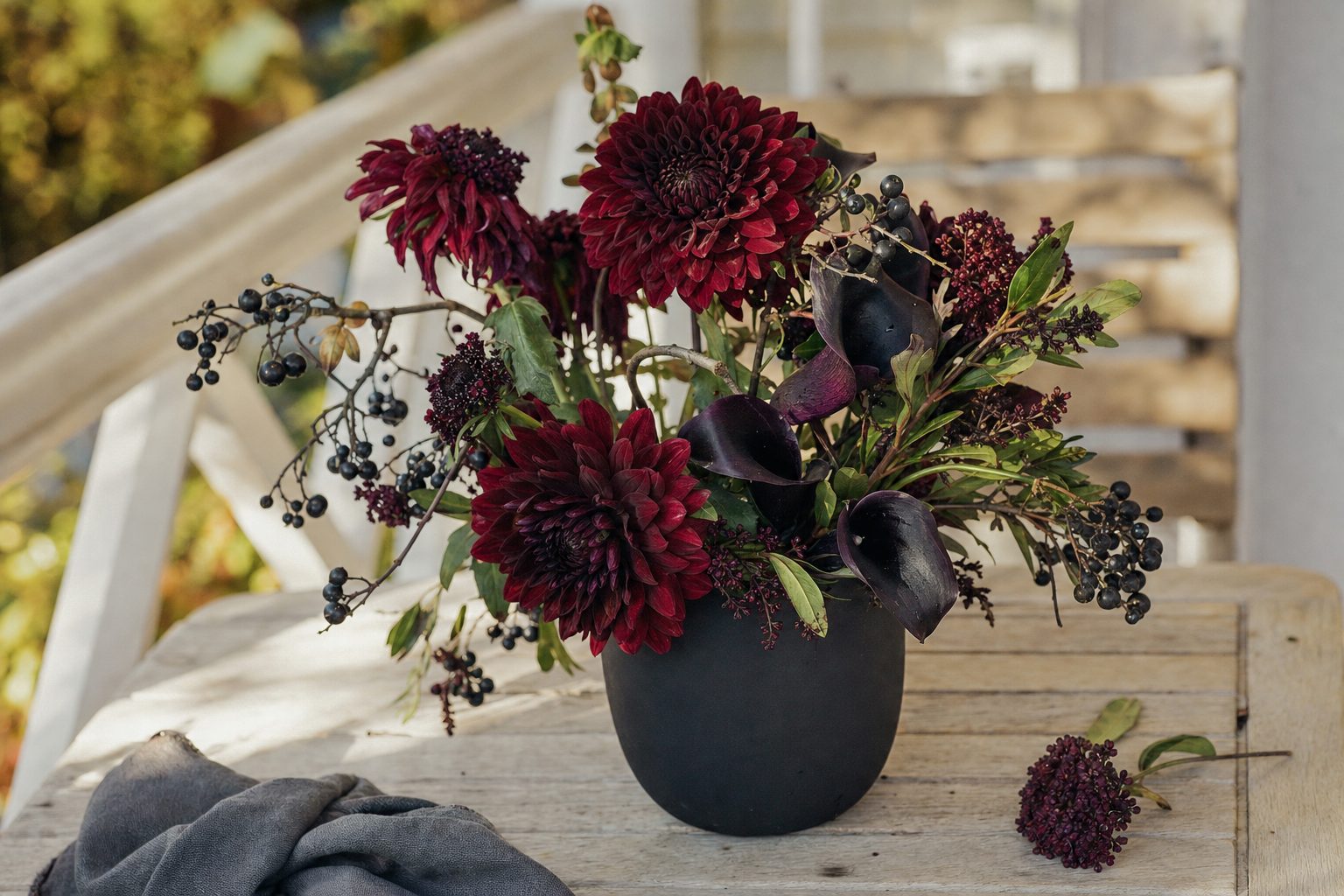
Every October, flower shops field the same request. Someone wants black flowers. Black roses, black calla lilies, a whole black bouquet for a Halloween party or a goth-leaning birthday or a photo shoot that exists mostly in their head. The florist nods, because she knows exactly what to pull, and she also knows she is about to have a short conversation about pigment chemistry. There is no black flower. There are flowers so saturated with dark pigment that in the right light, in the right company, they look black, and mid-October is the one stretch of the year when the most convincing of them are all in the cooler at the same time. That is worth knowing how to use.
Why nothing in the cooler is actually black
Petal color comes mostly from a family of pigments called anthocyanins, which produce reds, purples, and blues depending on their structure and the acidity of the cell sap they sit in. Pile enough of them into a petal, layer them over a dark background of other pigments, and you get a color that absorbs almost all visible light. What the eye reads as black is really a very dark maroon, an ox-blood red, a bruised aubergine purple, or occasionally a deep chocolate brown. Hold a so-called black rose up to a window and the edges glow red like stained glass. That is the whole trick.
Plant breeders have been chasing this for centuries without ever quite arriving, because true black would mean a pigment pathway that no flowering plant has evolved. Pollinators are not looking for black. They are looking for ultraviolet landing strips and bright contrast, so there was never much evolutionary pressure toward a flower that disappears against shadow. Everything dark in the trade is a human obsession, bred and selected by people who kept picking the moodiest seedling in the row. Knowing that changes how you shop. Stop asking for black and start asking for the darkest thing in the building, and you will get the good stuff instead of a disappointed shrug.
The darkest things you can really buy in October
Dahlias are the stars right now and will not be for much longer. Dark cultivars like 'Arabian Night' and the chocolate-toned ball types are as close to black as a garden flower gets, with a velvet surface that eats light. They come from local fields in most of the country, which means they are abundant and cheap until the night the temperature drops, and then they are simply gone. If you want dark dahlias this year, buy them in the next two or three weeks. Our first frost countdown explains why that cutoff is so abrupt.
Calla lilies in the near-black range, usually sold as 'Schwarzwalder' or similar, are the most reliable dark flower in the trade because they are greenhouse-grown year round and they hold their shape for ten days or more. Roses bred for darkness ('Black Baccara' and 'Black Magic' being the usual suspects) open a deep wine red and darken as they age, which is the opposite of most roses and very useful if you want the bouquet to look better on day four than on day one. Then come the supporting players: burgundy carnations, which are genuinely excellent and criminally underrated; dark scabiosa, sold under names like 'Black Knight' or 'Ace of Spades', with pincushion centers dotted in white; sweet william 'Sooty', almost unlit in color; dark lisianthus; plum-toned ranunculus as the season turns; and chocolate cosmos, which is a tuberous perennial with a near-black flower that genuinely smells of cocoa and vanilla. Chocolate cosmos is rare as a cut flower and worth asking about.
| What you ask for | What it actually is | October availability |
|---|---|---|
| Black rose | Very dark red, darkens with age | Year round, imported |
| Black calla | Deep aubergine purple | Year round, greenhouse |
| Black dahlia | Ox-blood or chocolate maroon | Now, until frost |
| Black tulip | Dark purple ('Queen of Night') | Late winter to spring |
| Black hellebore | Slate purple | Winter |
Note the bottom rows. Two of the most famously dark flowers in horticulture, 'Queen of Night' tulips and dark hellebores, are not October flowers at all. If someone shows you an inspiration photo full of black tulips and dusty hellebore, that photo was taken in March. Gently redirect.
Foliage, berries, and pods carry the drama
A bouquet made entirely of dark flowers turns into a smudge. What makes the look work is texture in the same tonal family, and October is generous here. Smoke bush foliage in deep plum, ninebark in near-black burgundy, dark loropetalum, copper beech while it holds, and purple basil if your florist works with herbs. Berries do even more: privet berries in glossy blue-black, elderberry clusters, aronia, viburnum in dark blue, and the black-stemmed cultivars of pussy willow that show up later in the season. Pods and seed heads read as dark because they are matte and dry, which makes them the ideal counterweight to glossy berries.
Build the arrangement with the structural stems first and drop the flowers in last and you will get depth instead of a mass. We went deep on this material in the guide to fall texture, and almost all of it works in a dark palette with no adjustment. Keep in mind that many ornamental berries are mildly toxic if chewed, which matters if you have a cat who treats every vase as a salad bar. The pet-safe flowers guide covers the stems to keep up high.
Dark flowers need a light source
Here is the practical problem nobody mentions. Dark bouquets look magnificent in a studio with a softbox and perfectly flat in a dim dining room at 8pm. Black absorbs light, so a vase of near-black dahlias set against a dark wall simply vanishes. The fix is contrast, and you only need a little. One of three things: a pale background, a pale accent flower, or a candle.
A pale background is free. Move the arrangement to a white wall, a light counter, a window. For accents, a few stems of white or acid green make the darks register as dark instead of as absence. White anemones with their black centers are perfect for this and arrive in force as the fall season deepens. Green hydrangea, green amaranth, white ranunculus, or pale garden roses all work. Resist the urge to add orange. The instant you put orange next to burgundy you have made a Halloween decoration, which may be exactly what you want, but it is a different bouquet. Candlelight is the third option and the best one, because flame picks up the red underneath the black and the whole arrangement warms up by a full shade.
About painted and dyed flowers
Yes, your florist can spray a flower black. Floral paint and airbrush tints are standard tools, especially in October and especially for events. A white rose coated in matte black floral spray is genuinely black in a way no living flower is, and for a one-night party or a photo backdrop it can look spectacular.
Understand the tradeoffs before you commit. Painted petals stiffen slightly and the finish can rub off on fingers, tablecloths, and dresses. Spray adds labor cost and sometimes a surcharge. The coating interferes with transpiration a bit, so a painted flower generally has a shorter vase life than its unpainted twin. There are also dip-dyed and absorption-dyed flowers, where white blooms drink tinted water and the color travels up into the veins, which looks beautiful in a different, more marbled way. None of this is cheating. It is just decoration, like glitter on a Christmas branch, and an honest florist will tell you which effect you are getting. If you want the arrangement to still look good on Thursday, ask for real dark varieties and save the paint for the one-night props.
Moody without going full costume
The best dark arrangements are not monochrome. They have range, from a mid-tone plum through burgundy to the deepest near-black, with one surprise. Think of it as a chord rather than a single note. A reliable formula: one third genuinely dark flowers, one third mid-tone wine and dusty rose, one third dark foliage and texture, plus two or three stems of something pale or sharply green to wake the whole thing up.
Color meaning is a nice secondary consideration if you are sending this to a person rather than a party. Deep red roses still say what they have always said, dark purple carries notes of dignity and mourning in some traditions and sheer drama in others, and a lot of fall flowers have specific associations that are fun to lean into. Our flower meanings guide is a decent place to check before you attach a card. One caution: a very dark arrangement can read as funereal to someone who was not expecting it, so if you are sending it as a birthday gift to a person who does not already own black lipstick, add white and let the card do some explaining.
Flowers that survive an actual party
Party flowers have a job description beyond looking good. They have to sit on a surface where people set drinks, survive being shoved aside for a cheese board, and not catch fire. Dahlias are gorgeous and will wilt in a warm room by hour three, so if you are hosting on a Saturday night, buy them Saturday morning and keep them cool until the doorbell rings. Calla lilies, carnations, and chrysanthemums shrug off a crowded room. Carnations in particular will look fine the next morning while everything else is drooping.
Keep arrangements under about ten inches tall on a dining table so people can see each other, and put the tall dramatic branch pieces on a console or mantel where nobody has to navigate around them. If candles are involved, position them so flame cannot reach dried pods or wheat, both of which are more flammable than fresh material. Water in dark vessels hides murk, which is convenient during a party and a nuisance afterward, so change it the next day rather than letting it go swampy under cover of darkness.
The vessel does more work than usual
Clear glass is a liability for a dark bouquet because you can see every stem and the water goes cloudy fast. Matte black, charcoal, pewter, dark glazed stoneware, rough concrete, and weathered brass all flatter this palette. A black ceramic cylinder is probably the single most useful piece you can own in October. Go the other direction and a white or cream vase works beautifully too, by giving you the pale contrast the arrangement needs without adding a single flower.
Avoid anything with a pattern. Dark flowers are already busy at close range, with layers and shadows competing for attention, and a patterned vase turns the whole thing into visual noise. Avoid an undersized vessel as well, because this palette looks best a little loose and wild rather than packed tight. If your cupboard is short on options, the vase wardrobe post lists the handful of shapes that cover almost every situation.
How to ask for this at the shop
Walk in or call and say something close to this: "I want the darkest flowers you have, as close to black as real flowers get, with dark foliage and berries, and a few white or green stems so it reads. My budget is X. I am open on varieties." That sentence does four useful things at once. It tells the designer the effect you want rather than a specific stem, it gives permission to substitute, it sets the number, and it signals you understand black is a direction and not a color.
Expect to pay a little above a standard bouquet of the same size. Dark varieties are grown in smaller quantities, dark dahlias are a seasonal luxury, and the textural fall material takes longer to assemble than a dozen roses. Broad honest range: a small dark arrangement in most of the country lands somewhere in the forty to sixty dollar neighborhood, a dinner-table centerpiece runs sixty-five to a hundred and twenty-five, and a mantel piece with branches goes up from there. If you want to get more out of the conversation, the florist phone call post has the exact script.
Care notes specific to dark varieties
Dark petals show damage more visibly than pale ones. A bruise on a white rose is a shadow; a bruise on a near-black rose is a crease of brown. Handle these stems by the stem, never the head, and do not jam the bouquet into a car's back seat under a coat. Heat is the other enemy, because dark surfaces absorb more radiant warmth and a bouquet sitting in afternoon sun will cook faster than a pale one in the same spot.
Otherwise the rules are the ordinary rules, which happen to actually work: clean vase, fresh cool water, flower food if you have it, recut the stems at an angle, strip leaves below the waterline, keep the arrangement away from ripening fruit and heating vents. Dark dahlias are the shortest-lived element at roughly four to six days, calla lilies and carnations the longest. If you want the display to hold two weeks, build around calla, carnation, and berried branches and treat the dahlias as the part that leaves early. For everything else, our rundown on what makes cut flowers last separates the methods that matter from the aspirin-in-the-water folklore.
Where the palette goes after October
This is the quiet advantage of going dark instead of going orange. A burgundy and plum arrangement does not expire on November 1st. Pull out any skulls, swap the blackest flowers for wine-colored roses and a few amber or rust accents, and the same color family carries you straight through November and onto a Thanksgiving table without looking like leftover party decor. Dark berries, seed pods, and dried grasses hold for weeks and can be rescued from the arrangement as the fresh material fades.
The flowers worth buying this month are mostly coming out of fields a short drive from wherever you are standing, and they will be gone the first hard night. A shop that grows or buys locally will know exactly which dark dahlias are still coming in and which ones finished last week, which is the sort of answer no national order page can give you. Find a real florist near you, ask what the darkest thing in the cooler is today, and let them show off. It is their favorite question all month.